


Inside the Amazon: The Human Cost of Mining an Ancient Rainforest

Updated: Feb 19
The Restored Lands Advocate
Explore this three part Amazon series
Part 1 of 3
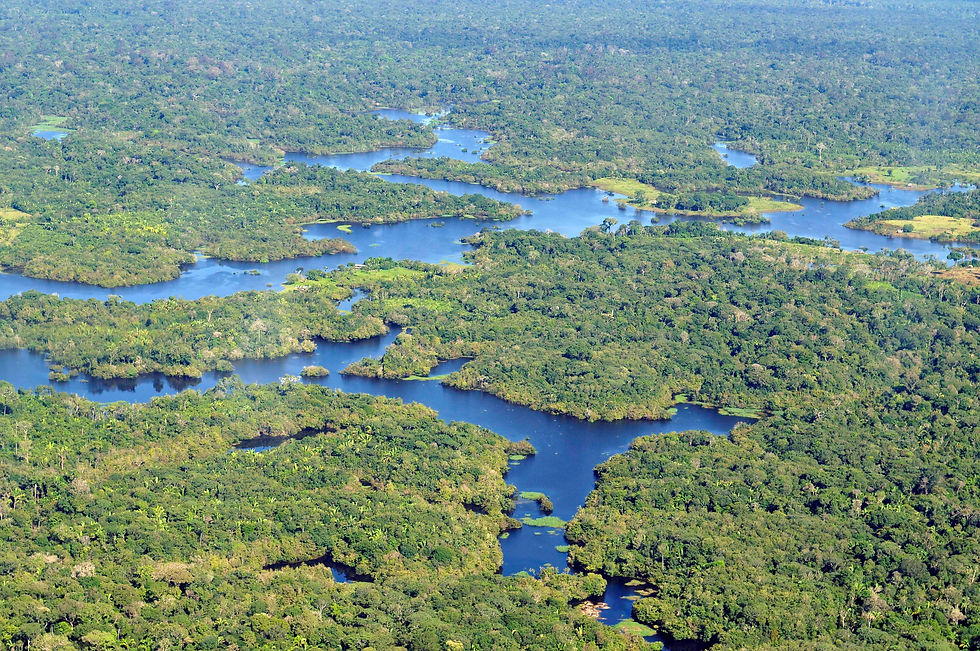
Did you know the Amazon’s destruction is directly impacting human life? With ongoing mining and deforestation, Indigenous communities are up against industrial threats like never before. Beyond destroying land Indigenous people have depended on and protected for centuries, environmental crime fuels an ongoing struggle marked by escalating violence, displacement, and cultural erosion.
What's Going in the Jungle
The Amazon Rainforest is the world’s largest tropical rainforest, regulating the global climate, supporting millions of plant and animal species, and home to various Indigenous groups. Across nine countries in South America, hosting an extensive river system and countless species, the Amazon is a vital ecosystem facing significant threats from overwhelming resource extraction. This ancient rainforest is home to Indigenous tribes whose cultures, food systems, and livelihoods are deeply tied to the forest, resulting in the Amazon’s destruction being immediate and personal to human life in the forest.

Environmental crime in the Amazon Rainforest has grown steadily over the past several years, largely due to increased global demand for natural resources or illegal trade. Things like timber, precious metals such as gold, drugs and exotic animals become the economy of the jungle, leaving behind massive scars on the landscape. While the region is often discussed in terms of biodiversity loss, the human consequences of this destruction receive far less attention. Understanding how environmental exploitation affects Indigenous communities is essential to understanding why Amazon conservation matters beyond environmental preservation alone.
Over the past two decades, conservationist Paul Rosolie, founder of Jungle Keepers, has worked alongside Indigenous communities in the Upper Amazon to protect large areas of threatened land. Together, they’ve been able to protect over 100,000 acres of rainforest, but despite their conservational efforts, mining and logging continues to expand across the land, threatening ecosystems and altering the landscape. However, in early 2026, the Junglekeepers reach is expanding with more attention on Paul and his mission as he infiltrates the mainstream podcast scene.
Mining in the Amazon Rainforest

Widespread legal and illegal mining activities continue throughout the Amazon Rainforest, with gold mining in particular expanding rapidly across Peru, Brazil, and Ecuador. This mining destroys ecosystems, pollutes rivers with toxic mercury, and creates social conflict, despite efforts by conservationists like Paul Rosolie and Indigenous groups combating these issues. Mercury often ends up in rivers and soil, contaminating water systems that Indigenous communities rely on for drinking, leading to neurological damage, and long-term cognitive and developmental disorders (Oliveira, 2021). Observations of individuals impacted by the widespread mercury poisoning of the Minamata and Niigata disasters in Japan in the 1950s showed various neurological abnormalities, such as visual field alterations and hearing impairments (Oliveira, 2021). Further ongoing research and studies conducted in the Amazon region have revealed similar casualties in Munduruku Indigenous adults from the consumption of contaminated fish (Oliveira, 2021). In many cases, the companies responsible are allowed to operate due to absent regulations, corruption, or government licenses that overlook Indigenous land rights.
The Associated Press has reported that, “international cooperation can be used to confront environmental crime,” yet mining remains unregulated and enforcement remains poorly distributed (Grattan, 2025). As a result, mining operations continue to expand faster than conservation efforts can stop them.
How Destruction in the Amazon Affects Indigenous Communities
Mining in the Amazon occupies over 20% of Indigenous lands, endangering critical ecosystems across 450,000 square kilometers (WRI, 2020). When rivers are polluted with mercury, fish populations decline or become unsafe to eat and directly threaten food security for Indigenous families relying on fishing and hunting to survive. Mercury contamination also affects soil quality and bioaccumulates within the food web, increasing health risks for Indigenous communities that rely on these food sources for survival. Additionally, deforestation is destroying medicinal plants, a vast carbon net, farmland, and sacred lands.
In some areas, the expansion of illegal mining and logging has turned Indigenous territories into sites of violence and intimidation. As outsiders invade protected lands, communities are often forced into direct confrontation in an effort to defend what they have relied on for generations. In 2019 alone, many Indigenous people lost their lives in attempts to protect their land from mining operations (WRI, 2020). Loss of land often results in displacement, forcing Indigenous families into unfamiliar environments where access to healthcare, education, and employment is limited. Over time, this displacement increases vulnerability and weakens communities’ ability to advocate for their rights.

Paul Rosolie and Indigenous-Led Conservation
One of the most notable aspects of Paul Rosolie’s work is its focus on collaboration rather than exclusion. Jungle Keepers recruits loggers and gold miners–who normally just happen to be locals trying to survive in the jungle–providing them with alternative income through conservation work and eco-tourism. This approach reduces economic pressure to exploit the forest while creating long-term protection for the land.
By working directly with Indigenous communities, Rosolie’s efforts support both environmental protection and Indigenous sovereignty.
Awareness and Action: What Can Be Done
While the impacts of mining and deforestation are severe for Indigenous communities, the long-term consequences extend globally. The Amazon Rainforest plays an enormous role in stabilizing the Earth’s weather, and its destruction accelerates biodiversity loss and climate change. Understanding these connections helps place Amazon conservation within a broader global context.
As Paul Rosolie said in an interview with Plan South America, “It starts with awareness and action” (PSA, 2024). The first step is knowing the realities of the Amazon and the Indigenous peoples. Beyond that, individuals can support organizations working directly on the ground while advocating for stronger environmental protections. Readers interested in protecting the Amazon can learn more about and donate to Jungle Keepers, an organization actively working to protect the Amazon Rainforest and work with Indigenous communities.
CONTRIBUTE TO JUNGLEKEEPRS HERE: https://www.junglekeepers.org/
Want to learn more about this topic? Check out:
Written by: Liyana Zaman
Edited by: Henry Passerini

Liyana Zaman is from Long Island, New York, currently pursuing a degree in Psychology at New York University on the pre-law track, with hopes of working in environmental law in the future. With a deep passion for environmental awareness and strong interested in how advocacy, education, and policy can create change, she is excited to contribute to the Restored Lands mission and protect our environment for generations to come!
References
Admin. (2024, April 22). The Amazon: A Forest of Rivers. Retrieved from Amazon Frontlines website: https://amazonfrontlines.org/chronicles/the-amazon-a-forest-of-rivers/
(2025, July 10). UAE-led operation targets Amazon crime network. Retrieved from AP News website: https://apnews.com/article/amazon-uae-environmental-crime-operation-arrests-8361b6e0570a00ac14b40aab62937efc
Oliveira, R. A. A. de, Pinto, B. D., Rebouças, B. H., Ciampi de Andrade, D., Vasconcellos, A. C. S. de, & Basta, P. C. (2021). Neurological Impacts of Chronic Methylmercury Exposure in Munduruku Indigenous Adults: Somatosensory, Motor, and Cognitive Abnormalities. International Journal of Environmental Research and Public Health, 18(19), 10270. https://doi.org/10.3390/ijerph181910270
Paul Rosolie - Conservationist. (2026). Retrieved January 9, 2026, from Paul Rosolie website: https://paulrosolie.com/conservationist
PSA. (2024, September 24). Paul Rosolie on Protecting Peru’s Amazon with Junglekeepers. Retrieved from Plan South America website: https://www.plansouthamerica.com/interview-paul-rosolie-junglekeepers-amazon-conservation-peru/
RELEASE: New Study Reveals Mining in the Amazon Threatens 20% of Indigenous Lands. (2020). Www.wri.org


Comments